Lucy Kirkwood’s latest play, The Human Body, is a timely, if somewhat flawed, reminder of the struggles it took in post-war Britain to create the National Health Service (NHS), now in its seventy-fifth year. A mix of political drama and a love story coloured in shades of David Lean and Noël Coward’s Brief Encounter, the play is ultimately enjoyable despite its confused aspirations.
Keeley Hawes stars as Iris Elcock, a doctor caught between her medical career, her political ambitions, and her family life in 1948 Shropshire. Iris, as a local labour councillor and a parliamentary secretary to Helen Mackeson MP, is at the forefront of the campaign led by Minister of Health Aneurin Bevan to create the NHS, a position that would be complicated enough without Iris’s added stresses. Hawes shines as a woman caught between who she is and who she wants to be, bringing strength to a role that could otherwise be too mired down in heavy-handed political monologues.
From the glimpses of life at the Elcock residence, with a disinterested and unpleasant husband and a daughter who’s more interested in the then-Princess Elizabeth’s wedding dress, it is easy to see how Iris sought out companionship with George Blythe. Her curiosity in covertly learning about George was particularly endearing, through her study of back issues of film magazines from the waiting room and casual probing of those around her.
Jack Davenport, perhaps best known for his turn as Commodore James Norrington in the first three Pirates of the Caribbean films and more recently as Jennifer Aniston’s ex-husband Jason Craig in The Morning Show, makes his highly anticipated return to the London stage as George Blythe, a Hollywood actor returning to his hometown due to family circumstances. Davenport plays George with his usual charm, equal parts debonair Hollywood veneer and tender conflict. The scenes between George and his family were particularly affecting, especially in the scene towards the end of the second act. His need for escapism is palpable, and it is easy to see how he falls for Iris.

George comes alive around her, unshackled from the burden of his home life. His amusement at the promotional newsreel about Iris at the cinema was a joy to watch, as was George’s over-the-top turn posing as Iris’s cousin visiting from Greece during a train ride home, displaying Davenport’s knack for comedic timing. It’s wonderful to see him back on stage after a majority screen-based career, and hopefully he’ll be treading the boards again in the not too distant future.
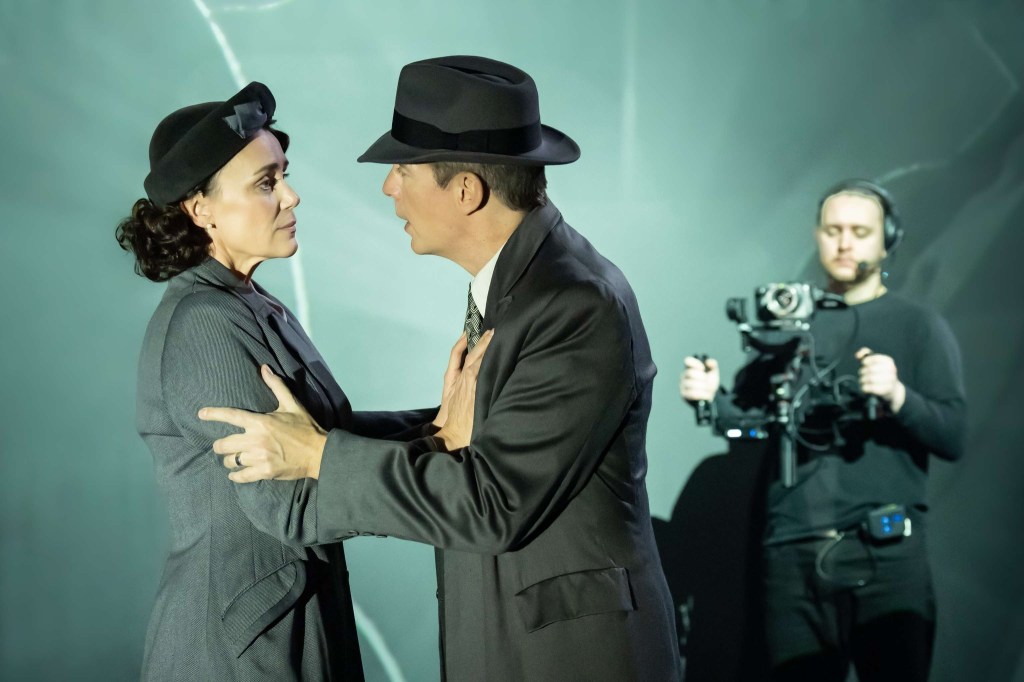
Iris and George’s doomed romance is a connecting thread throughout the play, and is where the influence of Brief Encounter is truly felt, even being referenced in a conversation the pair have about cinema. It can often be difficult to find sympathy when it comes to the depiction of affairs, but it was difficult to not feel compassion as Iris and George sought a connection in lieu of their loveless marriages. Davenport and Hawes share a wonderful chemistry as they navigate their relationship from a tentative friendship to quietly falling in love to the ultimate resolution. It’s a clear portrayal of the classic ‘right person, wrong time’ trope. Their moments together are highlighted by cinematic video design by Nathan Amzi and Joe Ransom (Sunset Boulevard) as well as soaring strings by sound designers and composers Ben and Max Ringham (Prima Facie; A Doll’s House) redolent of the golden age of cinema romances that Kirkwood’s play pays homage to.
The supporting cast is made up of Tom Goodman-Hill (Humans; Mr Selfridge), Pearl Mackie (Doctor Who), and Siobhán Redmond (Top Girls), who juggle supporting characters with skill and many a quick change. Goodman-Hill deftly balances more comedic characters such as the American Reporter and Mr Flack with the role of Iris’s unsupportive and melancholic husband, Dr Julian Elcock, often in a matter of moments. Mackie exudes charm and vivacity in all of her roles, with some touching moments as Sylvia Samuels and Averill Hughes that show her range as a performer. As Helen Mackeson, Redmond brings brings a fire to Iris’s final ultimatum. Flora Jacoby Richardson gave a pleasant performance as Laura Elcock. Many of these smaller characters could come off cartoonish, but the cast do well to ground them.
Fly Davis’s (Caroline, or Change; The Ocean at the End of the Lane) design is a simple one, highlighting the austerity of the late 1940s. The cast are largely dressed in muted greys, with the odd burst of colour, and the props are NHS Blue. Whilst this does highlight the bleakness of an era where rationing was still in place, it makes for dull visuals in a fairly monochromatic colour palette.
The Stage Management team on this production are omnipresent throughout, handling props and cameras, and performing some of the slickest scene changes on a revolving stage that have been seen for a while. They fully deserve their place alongside Hawes in the final bows, a trend that I hope will continue in future productions that highlights the value and hard work of the backstage teams.

The play, much like Iris, seems torn between romance and politics, jumping back and forth in what can sometimes be abrupt changes of gear that do not necessarily work to its benefit. The audience shares in Iris’s confusion, and it would have been more effective to choose one aspect to focus on. Despite its long running time, the play rarely drags, although a further trimming of the script would not have necessarily gone amiss. Outgoing Artistic Director Michael Longhurst co-directs with his Next to Normal collaborator Ann Yee, and the pair have provided their cast with a steady guiding hand. But it is the cast that are easily the standout in this production, elevating what would have otherwise been a middling piece.

The Human Body runs at the Donmar Warehouse in London until 13th April. Limited tickets are available here.
Photo credits: Marc Brenner
 Common Thread
Leave a comment