This article contains spoilers for Cabaret.
There’s no doubt that Cabaret was progressive when it premiered on Broadway in 1966; what’s surprising is that it remains as jarring and relevant today as it was then. The show, written by Joe Masteroff with music and lyrics by John Kander and Fred Ebb, seems to be on every theater fan’s mind right now, after Eddie Redmayne’s polarizing performance as the Emcee at the Tony Awards on June 16. Personally, the show’s been on my mind since I saw Justice Theater Project’s production at the Umstead Park United Church of Christ in Raleigh, North Carolina.
I was vaguely aware of Cabaret for many years (how could any theater fan not be?), but I first saw it last summer in London. The West End production, which has since transferred to Broadway, opened my eyes to how radical it still feels, regardless of the nearly sixty years since it debuted. I was thrilled to see a local production, and very impressed with how well the show holds up even with a more simplistic set and in a non-traditional theater space.
Cabaret has had several successful revivals on Broadway and in the West End before the current one, as well as a fairly universally beloved 1972 film starring Liza Minnelli and Joel Grey. The show was inspired by John Van Druten’s 1951 play, I Am Camera, which was an adaptation of Christopher Isherwood’s 1931 semi-autobiographical novel, Goodbye to Berlin.

The story follows several characters in 1929 Berlin, in a world of rundown boarding houses and seedy nightclubs where queer life and tolerance abound. Clifford Bradshaw is an American trying to write his great novel, who falls into a relationship with English cabaret singer Sally Bowles. She performs at the Kit Kat Klub, where the Emcee leads the audience through the action of the show. Meanwhile, Cliff and Sally live in a boarding house run by the elderly Fräulein Schneider, who is being courted by the Jewish fruit vendor, Herr Schultz.
The show explores the Nazis’ gradual rise to power, and how many of those living in Germany were slow to take the political turmoil brewing seriously. Part of the power of the show depends on the audience’s knowledge of what is to come shortly after it takes place, including the Nazis shutting down cabaret clubs and placing queer people into concentration camps, alongside Jewish people and other minority groups and political prisoners. It’s estimated that 10,000 to 15,000 men were sent to camps for homosexuality, with thousands dying or having medical experiments done upon them. (You can find more information here.)
The Justice Theater Project’s Emcee is played by Jordan Clifton, a local actor and the Theatre Director at Broughton High School. He’s also an American 250 Fellow and a recent Fulbright Fellow, in addition to his work with A+ Schools of North Carolina. In an interview with Culture Cabinet, he shared that he’d never seen the show before playing the role. “I knew, of course, Joel Grey and Alan Cumming,” he said. However, the Emcee wasn’t a role that he had considered for himself. He said, “It wasn’t a role that was on my bucket list to play. But it kind of found me and the timing worked out.”
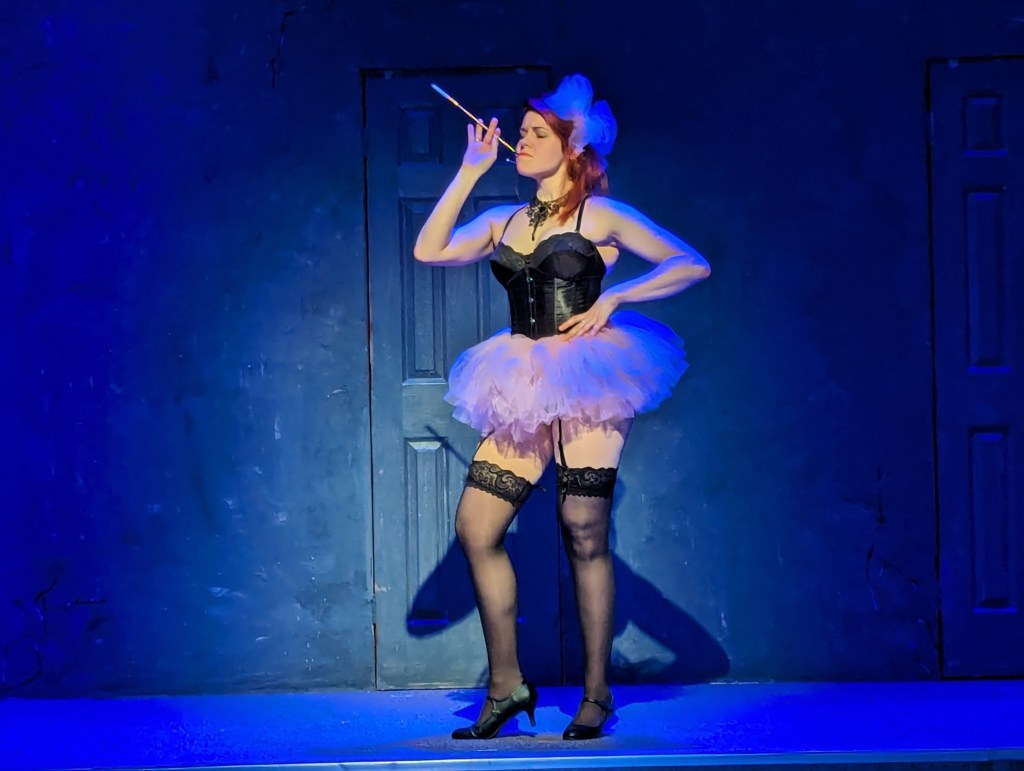
Bridget Patterson plays Sally Bowles, adding it to a repertoire that includes Gwendolyn in The Importance of Being Earnest, Magenta in The Rocky Horror Show, and Jill in Equus in local productions. She grew up with the music from the show as her mother, who’s also a voice teacher, is a big fan of Liza Minnelli. About ten years ago, she attended Playmaker Theater’s production of Cabaret and was surprised by how dark the show is. Like Clifton, she wasn’t expecting to ever play this role. “I never thought I’d get to be a part of it ever,” she admitted but was glad that director Nancy Rich encouraged her to audition after having worked with her on plays.

Both performers put in hard work to prepare for their roles but steered clear of watching any previous iterations of the characters. Patterson praised the dialect coach Rebecca Bossen for helping her build the character, stating that she tried to make it “lower class [English], but like she was reaching all the time to sound more elegant and upper class.” Patterson’s Sally fluctuates between more proper RP English and a Cockney twinge throughout the show, depending on her moods. It helps establish the character as someone who’s continually pretending to be someone she’s not.
Patterson also watched old movies from the 1920s through 1940s, including The Sleeping Car and Casablanca, to “ground herself in the time period” and to get an idea of the “alluring beautiful starlets” that Sally herself would have watched in movies. “When she finds the cabaret,” Patterson explained, “I think that’s what she wants to embody, the persona she tries to put on.”
Part of what makes Patterson’s Sally so fascinating to watch is how she builds the layers of the character: the performer onstage, the performer offstage, and the true Sally of whom we only get rare glimpses. “There are many different versions of Sally,” Patterson confirms. “A lot of the way that Sally portrays herself depends on her mood, like all of us.”
The Emcee is a difficult role to delve into because he’s more showman than actual character. Clifton said, “Kander and Ebb basically took what Brecht was doing in Germany and ran with it, especially in Chicago and Cabaret.” In addition to learning the songs and choreography, he did physical gesture work and used what American actors call “the V effect” (the nickname for the German word Verfremdungseffekt).

He said, “I did some research on what the world was like because the Emcee is not really mentioned in the original text [of Isherwood’s novel].” Learning more about Germany in this time period helped him construct the character. “I didn’t realize how progressive and liberated the city of Berlin was in the early 1900s through the 1920s,” he said.
Part of the character-building happened once he had the chance to work with the rest of the cast. He said, “Bridget and I had a chance to sit down and figure out what our story was within the context of the show…We made a lot of really great discoveries in the room.” Both actors praised their director Rich for allowing them the opportunity to come to some of these realizations organically.
The process was not without its challenges. Patterson discussed how “physically and emotionally exhausting” the show can be, especially due to its dark subject matter. But she also found it equally challenging and cathartic because of how she relates to the character of Sally. She said: “I’ve struggled with vices like she has. If I’m being honest, I have been through a really devastating breakup, much like this character, and had to make choices to look out for myself…I think the biggest challenge has been how much I relate to her and how much I see my own flaws in her.”
While that could be painful at times, Patterson also noted that it allowed her to “process myself as I processed Sally through grief and anger and survivalism, as a woman in this world.” This ability to heal and understand ourselves through art is why it’s so important, according to Patterson and I completely agree.

Another challenge was figuring out how to get to the bottom of a character who willingly disregards the discrimination and political turmoil building around her. Sally is the sort of morally grey character we typically only see men play onstage. But Patterson was able to recognize that many people are guilty of turning a blind eye to what’s going on in the world. “We’ve all allowed ourselves to be a little myopic at times, to focus on ourselves and not pay attention to politics…and then you get surprised by what’s going on in the world.”
It helps that Sally’s emotional journey “was all-consuming in its own right from my perspective as an actor,” Patterson said, so she “kept [herself] busy with the emotional work of becoming Sally Bowles and allowed [herself] the grace of not paying too much attention to the politics of the play.”
Meanwhile, Clifton’s challenges lay in keeping the role feeling fresh particularly due to the venue being so intimate. “I have relished the element of improv that can happen in the show,” he said. “With eye contact with audience members, I’m able to break that fourth wall.” He expanded, “I’ve done shows on a large proscenium stage where I don’t even see a face necessarily, but to be able to look into someone’s eyes and make that connection, it sticks with you.”
Clifton’s Emcee is charismatic, easily engaging the audience with classic songs like “Willkommen” and “Money.” He easily toes the line between being quirky and winning the audience’s trust, making later moments in the show feel like a betrayal. He says, “At the top of the show he pulls the audience in…sure, he’s this garish, somewhat gross character, but I think he’s more charismatic and entertaining, like the showman type.”
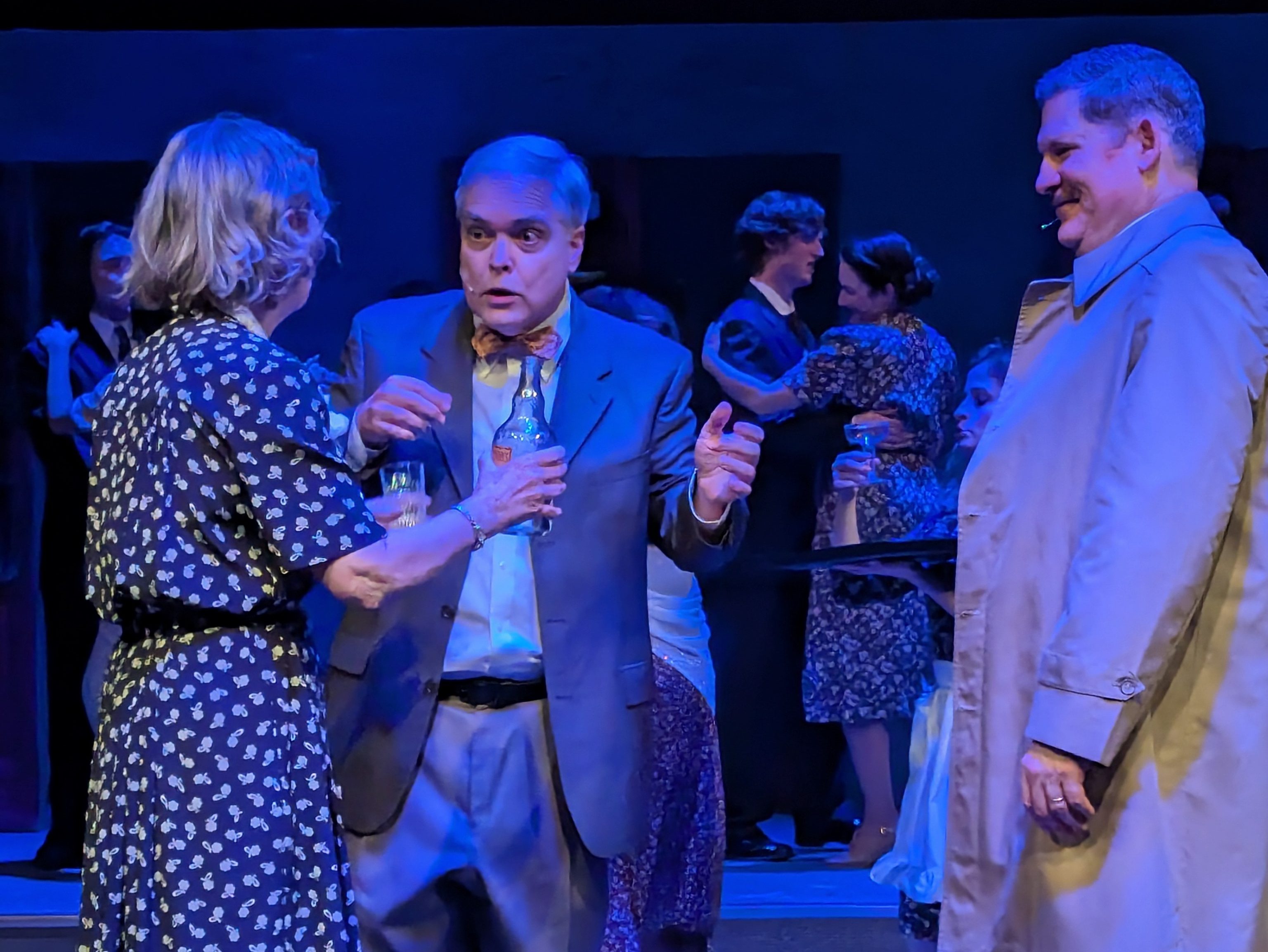
He spoke about the Emcee’s betrayal of the audience, who tend to naively assume that he’s on their side, in the number “If You Could See Her. He said it’s “a fun, silly song about a gorilla until the line, ‘She wouldn’t look Jewish at all’ is delivered.’” He says that the audience’s reaction differs every night and he enjoys getting to hear individual people’s response. The character has no dialogue, so Clifton “went through the motions of this person, as the Emcee living in Berlin, who would probably be able to blend in and kind of hide behind being a European, Aryan-looking person.”
But the Emcee is also at risk in the Nazi regime. “I was playing with some gay honesty, which goes back to Joel Grey,” Clifton noted. “Some of that you could hide, but then at a certain point, all it takes is one person from the community to out him and he’s shipped off to Dachau or Auschwitz.” That makes the ending moment of the show, which borrows from Sam Mendes’s 1993 London revival at the Donmar Warehouse, in which the Emcee is revealed in a concentration camp uniform feel like a sort of resolution to the character’s earlier anti-Semitism.
Clifton shared, “For me, it’s kind of cathartic, at the end of the show, because there is so much betrayal in what happened. Then the end is almost like a punctuation moment.”
Patterson and Clifton shared that the cast has been taking care of each other, to protect their mental health while portraying dark and horrifying events in history. Clifton said that Artistic Director Jerry Sipp “has been great with providing resources for us as a cast.” He also shared that they waited until going into tech rehearsal to use some costumes and prop pieces.
Patterson and Clifton, along with several other cast members, attended the Chappell Roan concert at Red Hat Amphitheater on a Wednesday during the run. I also attended, just days after seeing Cabaret, and it struck me how special it was to have a gathering of queer people listening to queer music by a queer musician in an open space. The cabarets of Germany allowed a queer culture to thrive, but only behind closed doors.

I asked both how it felt to be performing a queer musical during Pride Month and at a time when things like drag and queer rights are under attack in our country. “It means a lot,” Patterson said. “I mean, does it help? I hope it helps somebody.” Clifton said, “To be an actor who identifies as a gay man and never gets to play gay onstage, it’s a damn delight to just kind of live in my own skin and enhance that a little bit and add some more spectacle to it.” He added, “To think that there might be someone seeing the show who feels like they can live in their truth a little bit more after is really special.”
Both actors reflected on the way that the show demonstrates a part of history that has often gone undiscussed in the century since. “There’s always something to be learned from history,” Clifton said. “To just think how much progress had been made in Berlin in the 1920s. It’s wild to me to think about if the rise of Hitler hadn’t happened, where they would have gone in the 1950s, but it erased so many lives.”
Patterson noted that when they researched Berlin in the 1920s and 1930s, they found that it was “really progressive [with] safe spaces for queer people, even trans people.” She mused, “It’s almost like this little Camelot, this idyllic safe space.” These bars were shut down when the Nazis came to power, and Patterson notes that we’re seeing a similar effect today. “Not exactly bars being shut down, but violence against trans people and the LGBTQ community again and again. It’s important to remember Camelot and that there is a different way to be.”
Patterson, Clifton, and I agree that Cabaret serves as a “cautionary tale.” It’s a reminder of how quickly a seemingly liberated and progressive society can be brought down into discrimination and horrific treatment of our neighbors. Patterson and Clifton both seem very aware of the weight of the tale they’re telling and its relevance to life today. The Justice Theater Project’s production of Cabaret accomplishes all that you could hope the show would, while showcasing some of Raleigh’s amazing local talent.
Cabaret is playing through June 23, 2024.
 Common Thread
Leave a comment