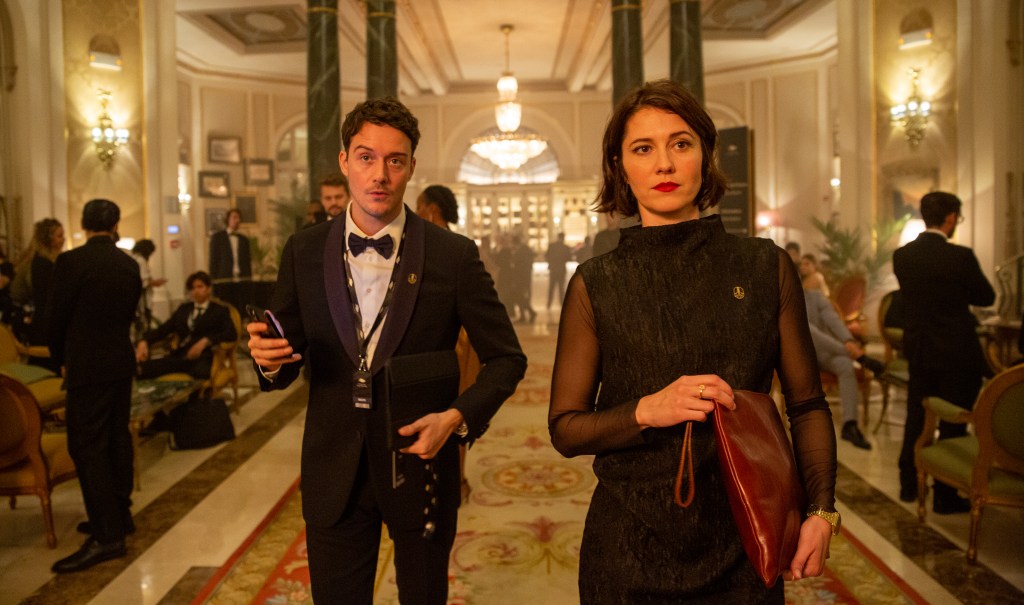
What would happen if there were an epidemic that affected only the wealthiest people? A disease that could specifically target the most privileged of humanity? Galder Gaztelu-Urrutia Munitxa’s aptly named film, Rich Flu, explores this concept. It’s the product of the writer-director’s lifelong love for science fiction and the culmination of many years of work.
While Rich Flu premiered at the 57th Sitges Film Festival in October 2024 and was released in Spain in early 2025, it only became available to watch in the United States this June. I got to chat with Munitxa about the film and delve into his influences, how his background shaped it, and his approach to creating a complex female lead.
Rich Flu follows Laura (Mary Elizabeth Winstead), a corporate executive who has just reached success as the pandemic targeting the rich starts to spread across the world. Suddenly, the wealth she has ruthlessly pursued for the sake of providing her daughter Anna (Dixie Egerickx) with a better life puts her family – including her ex Toni (Rafe Spall) and estranged mother Martha (Lorraine Bracco) – in danger.
The film satirizes the ultra-wealthy with characters like the pompous Sebastian Snail Jr. and his eccentric (and equally odious) son Sebastian Snail Jr., played to great comedic effect by Timothy Spall and Jonah Hauer-King.
It’s no wonder that Munitxa counts films like 2001: A Space Odyssey, Alien, and Blade Runner as creative inspirations, considering the old-school science fiction feel of Rich Flu. “Those are the movies that pushed me to be a filmmaker,” he tells me.
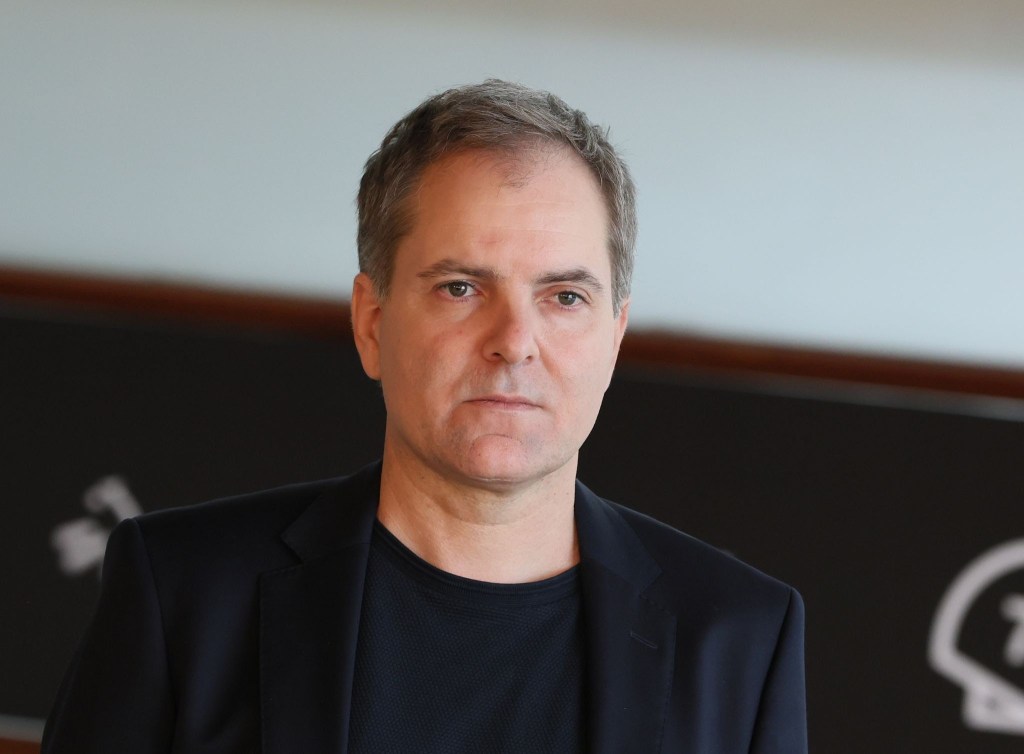
But the film is also clearly influenced by Munitxa’s background in business, as the beginning depicts Laura’s career in film financing. “I studied international trades, and that’s obviously been an influence for me,” he says. “I am very interested in social, socio-economic, socio-political paradoxes in fantastic contexts, and of course, I like to portray the business universe, which is the market, or the business that I know very well – the film industry. That’s why we chose to tell the story from that point of view.”
Munitxa developed the script with writers Pedro Rivero, David Desola, and Sam Steiner. The initial idea was De Sola’s, who was interested in exploring the concept of a virus that only affected the wealthiest people. During that period, Munitxa was working on “a reverse migration story, a story that could be told in first-person through the point of view of a privileged person from the Global North, who under normal circumstances never would be persecuted or discriminated.”
The two filmmakers decided to combine their ideas, working with writer Pedro Rivero to create the script’s English translation and bringing in Sam Steynan to ensure the London setting for the first half of the film felt natural.
“The important thing in the movie is that all the crises we have experienced historically have shown us that the more you have, the more chances you have to go on, but what would happen if precisely the real danger is in the superpower that makes some people untouchable: wealth,” Munitxa says.
The collaboration between writers also gave the movie its multi-country setting, as it takes place between London and Barcelona, along with other locations. “We wanted to make a multicultural movie,” Munitxa explains. “We wanted a movie that starts in the global north, and then as the crisis increases, they move to the global south. Of course, Laura is a person who desires professional success, and the richer the country you’re in, your professional success is going to be higher, so she wants to live in the high-class area of London. What we see is because of the crisis, she has to move to two other countries, as she is persecuted.”
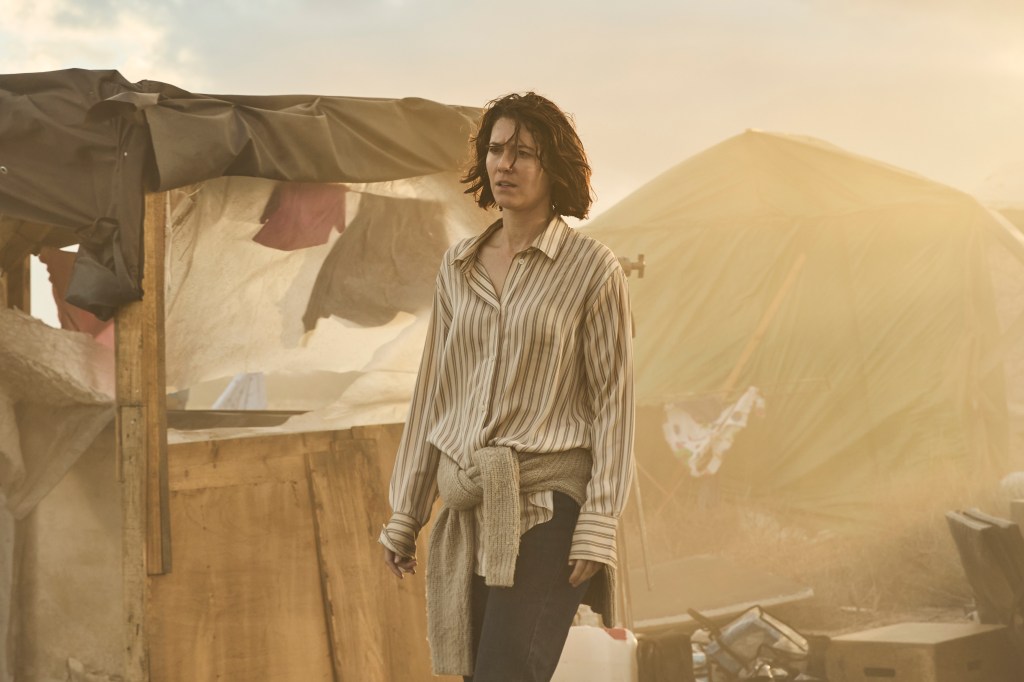
Laura is a difficult main character at times, and it can be frustrating to watch her as she seemingly makes all the wrong decisions with questionable motives. “Laura is a difficult protagonist of a movie,” Munitxa admits. “I have to say that my biggest inspiration to create, or co-create, this character has been myself, so here are my internal struggles.”
Of actress Mary Elizabeth Winstead, who portrays Laura, Munitxa says, “She’s very professional, very talented, and what I love about her is her ambiguous expression. She can be cold, distant, but also warm, close, and fragile, desolate. She has an incredible ability to hide her feelings.” Indeed, Winstead’s portrayal of Laura is what keeps the film engaging, even when Laura’s actions are exasperating.
“As we said, she’s a difficult character, but she’s a very realistic character,” Munitxa says. “She wants her professional success over everything, and if in that way she has to trample another person, if she has to trample over another woman, she will do it.” The realism of her self-centeredness makes her “the most interesting character to face the debates that we want to spark [with] this movie.”
Laura is the sort of complex main character that we’ve often seen men play in cinema, but much more rarely get to see women take on. Considering Rosamund Pike’s roles in Gone Girl and I Care A Lot, it’s not surprising that she was originally tied to the production back in 2022. But it’s exciting to get to see another actress play this sort of complicated character.
Munitxa shares that the team had many discussions around having a woman character make the choices that Laura does. “We found ourselves in an uncomfortable situation, being a bit paternalistic, and we thought, wow, we have seen in the history of cinema male characters doing incredible atrocities. Why should they have this care with a female character?” So they decided to go ahead with the character, even the scenes in which she betrays other women.
Munitxa’s passion for this project is palpable in our conversation. “This is probably, for me, the best movie I have made, and I love it. It’s been a real challenge to make it, to finance it.” He tells me that the project began before the COVID-19 pandemic. “You can imagine how long it took us to finance it!” he quips. It’s fascinating to consider how differently this film about a worldwide pandemic might have been received before we experienced our own.
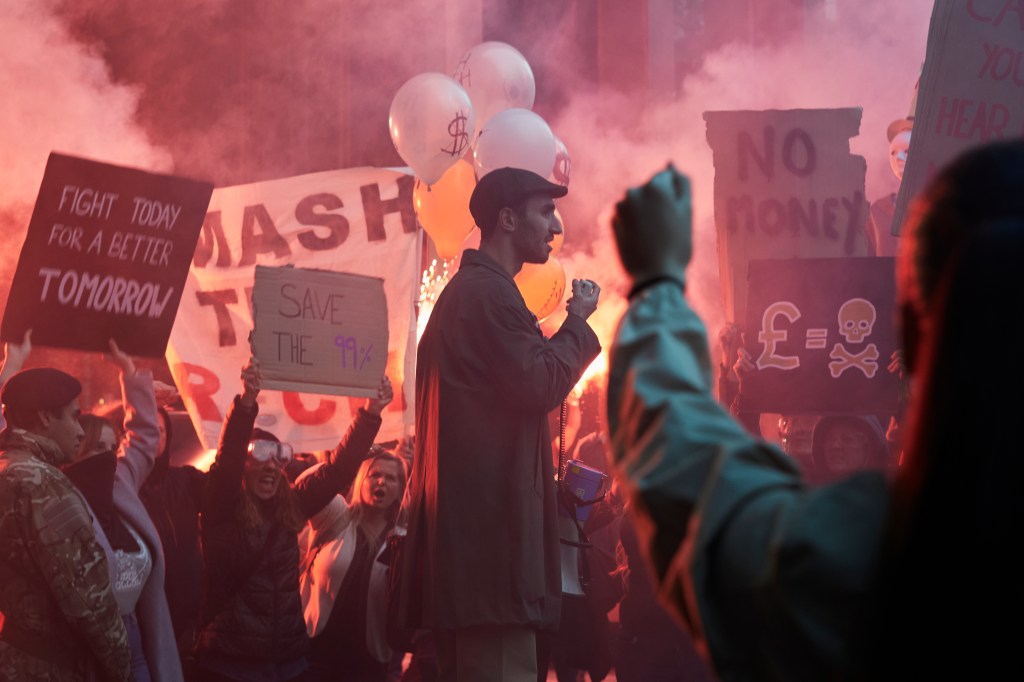
While the first part of the film focuses on the mounting global panic and the portrayal of the wealthy, the second part becomes much more of a survivalist adventure story as society completely collapses. “I love the first part, the satirical black humor,” Munitxa says. But it’s the second part that pushes viewers to confront their own ideas around wealth and society.
“At the end of the day, we make movies. We don’t want to preach, we don’t want to mobilize, we don’t want to patronize anyone,” the director explains. Instead, he and his co-writers hope to spark debate and make the audience ask themselves what they would do in a similar societal collapse. “When you make a movie to provoke this debate, you have to be prepared to have different opinions, and we respect all of the opinions, of course,” Munitxa says.
From another director, this attitude might seem like a cop-out, a way to step around taking any sort of moral standing towards the “eat the rich” attitude that has become all the more prevalent over the last few years. However, from Munitxa, it seems like a genuine wish for more public discourse around what wealth (both the possession of and the lack thereof) does to people.
“We love to talk about the distribution of wealth, and especially to talk about how we treat people that we think we don’t need,” Munitxa says. “At the end of the day, we want to have a conversation with the audience, making them part of the contradictions that we have. I truly believe in the fair distribution of wealth, but at the same time, the more I have, the more I want,” he admits. “You are going to find these kinds of debates in the movie, and we are happy if the viewers participate in them.”
You can rent or buy Rich Flu on Apple, Amazon, or YouTube.



Leave a Reply